
How do we know which hills are worth dying on?
Every pastor has watched a church argue over something that didn't matter, or stay silent about something that did. Dr. Gavin Ortlund joined our Converge Great Lakes pastors and leaders on a recent Zoom In Leadership call to talk about exactly that tension, and how to hold truth and love together without losing either one.
Gavin is an author, pastor, apologist and the president of Truth Unites, a ministry that aims to "promote gospel assurance through theological depth." He also serves as theologian in residence at Immanuel Church in Nashville. His book Finding the Right Hills to Die On introduces a tool he calls theological triage, and his conversation with Ken Nabi was one of the most practical hours we've spent together.
Watch the full conversation on Vimeo (about 59 minutes)
Here's a taste of what he shared.
Two ditches on either side of the road
Gavin opened with an old saying: there's no doctrine a fundamentalist won't fight over, and no doctrine a liberal will. Most of us lean one way by personality or past experience, and both directions lead to error.
Doctrinal separatism is quick to divide. It loves clarity but can miss how destructive lovelessness is.
Doctrinal minimalism avoids fighting over doctrine. It grieves the lack of love in the church but can be naive about how doctrine erodes over time.
Scripture models both postures. Paul has "Galatians 1 moments" where he throws down the gauntlet, and "Romans 14 moments" where the message is, in Gavin's words, "Hey, chill out." Jesus is gentle and lowly in heart, yet he also cleansed the temple. Different errors call for different responses.
Why it matters: when we get this wrong, pastors are unjustly fired, churches split (or fail to separate when they should), our witness suffers with non-Christians, and young people walk away. "The solution, of course, is not that we never disagree," Gavin said, "but it's how we disagree."
He pointed us to Jesus' prayer in John 17 and to Ephesians 2:14, where Christ tears down the dividing wall of hostility. He also shared a line from Charles Spurgeon about loving fellow believers he disagreed with: "Unless I can leave off loving Jesus Christ, I cannot cease loving those who love Him."
At the same time, Gavin was clear that something can be non-essential and still matter deeply. His example was Christ's intercession. It isn't required for salvation, yet he called it "like oxygen" for his daily walk.
Theological triage: sorting doctrines by weight
Triage lets us contend for what we believe while still treating those who differ as brothers and sisters. Gavin offered four tiers as a starting point, and he's open to people using more.
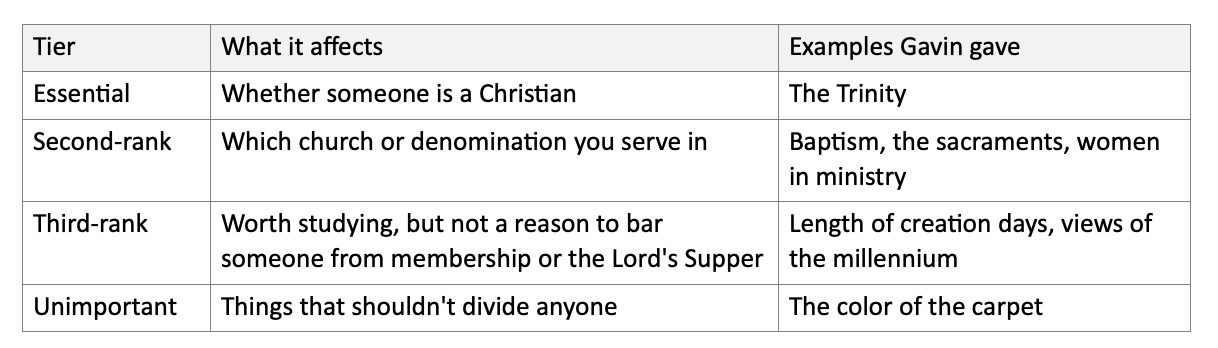
This isn't a new or soft idea. Gavin noted that Jesus spoke of the "weightier matters of the law," that Paul called the gospel "of first importance" (1 Corinthians 15:3), and that Calvin and Turretin both distinguished primary doctrines from secondary ones.
So how do you decide which tier something belongs in? Gavin keeps four questions handy:
How clear is it in the Bible?
How attested is it in church history?
How important is it in church life?
How is it connected to the gospel?
Ken added a Converge example: our movement ties believer's baptism to local church membership, and our Swedish Pietist forebears paid dearly for that conviction. Church history helps explain why it matters to us.
From the Q&A: what our pastors asked
The last stretch of the call was pastors bringing real situations from their churches. A few highlights:
Why are we so polarized? Gavin pointed to social media and cable news, which make the extremes louder. Many of our people, he said, are being "catechized by social media" more than by their pastors.
Women in ministry: second tier or third? He argues for second tier, mostly for a practical reason: every local church has to land somewhere on who serves as elders. He also urged both sides to stop assuming the worst. Not every egalitarian is liberal, and not every complementarian is abusive.
Unwritten rules and "silent tribalism." His answer: lean on your statement of faith. It keeps people accountable to what you believe, and it also keeps anyone from adding requirements it doesn't contain. "We don't have any authority to go further than it," he said, "and this is what helps us against legalism."
Leaders who are passionate about third-tier issues. Don't force every conversation. Pray for an open door, and point people to trusted heroes of the faith, such as Augustine or Spurgeon, who held a different view. The goal is an irenic spirit: we disagree, but we live in peace.
Building a healthier culture across the movement. Gather in person when you can, model good disagreement, and keep teaching both values. "Apostolic commandments are not options," Gavin said. Love and unity are matters of obedience.
Keep learning
Ken came to know Gavin's work while studying Converge's Pietist roots. Gavin is one of the few voices regularly talking about an irenic spirit, and he models it too. That's why this conversation fits who we are: we unite around the gospel, not secondary issues.
Gavin recommended these resources for going deeper:
Truth Unites, Gavin's website, plus the Truth Unites YouTube channel
Finding the Right Hills to Die On, Gavin's book on theological triage
The Center for Baptist Renewal, which helps Baptist churches reconnect with church history
The 1689 London Baptist Confession, which Gavin called "easier to read than you expect"
Watch the full conversation with Gavin Ortlund here, and consider watching it with your elders or staff team. You've been called on a mission. Don't go at it alone.
